The Ultimate Guide to Cataract Lenses: A 2025 Scientific Review
- Category: Lenses
- Date: 12-12-2025
By Dr. Pratyush Ranjan Cataract, Refractive & Glaucoma Specialist
One of the most common questions I hear in my clinic is, "Doctor, which lens is the best?"
The honest answer is: There is no single 'perfect' lens. There is only the perfect lens for your specific lifestyle and eye anatomy.
Cataract surgery has evolved from simply removing a cloudy lens to a precision refractive procedure. Today, we don't just restore vision; we design it. As we move into 2025, the technology available is more advanced than ever before.
Below is a scientific review of the top Intraocular Lenses (IOLs) available today, categorized by how they function, to help you make an informed decision.
1. Monofocal IOLs: The Gold Standard for Clarity
The Mechanism: These lenses focus light at a single distance (usually far).
Best For: Patients who prioritize absolute clarity and night driving safety, and do not mind wearing glasses for reading or computer work.
The Top 3 Picks:
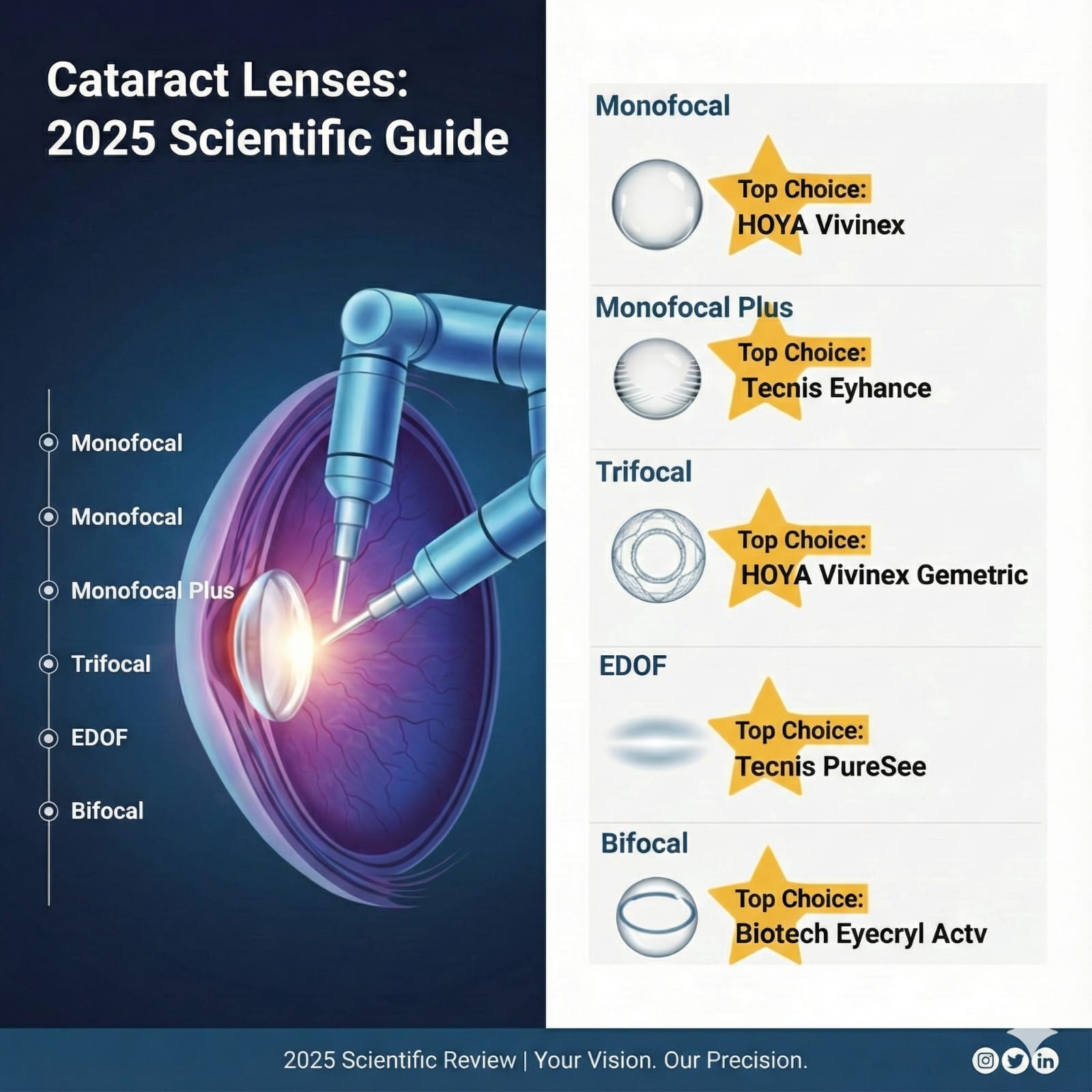
? Top Choice: HOYA Vivinex iSert ?
Why it wins: Safety, Sterility, and Clarity.
The Science: The HOYA Vivinex is our top pick for three scientific reasons:
No-Touch Preloaded System: It comes in a preloaded injector, meaning the lens is never touched by human hands or instruments, significantly reducing infection risk.
PCO Prevention: It features a unique "Active Oxygen Processing" surface treatment that adheres to the lens capsule, scientifically reducing the risk of developing a "secondary cataract" later in life.
Glistening-Free: The hydrophobic material is chemically stable, ensuring the optic remains crystal clear for decades.
Alcon Clareon:
The Science: This is the current benchmark for material stability. It uses an advanced hydrophobic acrylic material that is practically immune to "glistenings" (micro-vacuoles that can form in older lenses over time), ensuring your vision stays clear for decades.
J&J Tecnis 1-Piece:
The Science: Known for superior Chromatic Aberration Control. It has a high Abbe number (55), meaning it focuses different colors of light very precisely on the retina, offering high-contrast vision.
2. Monofocal Plus: The Modern Upgrade
The Mechanism: These lenses modify the surface curvature to provide distance vision plus improved intermediate vision (dashboard, desktop computer).
Best For: Drivers who want to see their speedometer clearly without glasses.
The Top 3 Picks:
? Top Choice: Tecnis Eyhance ?
Why it wins: "The Halo-Free Upgrade."
The Science: Unlike multifocal lenses that use rings to split light, the Eyhance uses a breakthrough refractive surface design. The power of the lens increases continuously from the periphery to the center.
The Benefit: This provides roughly 30% better intermediate vision compared to a standard monofocal. Crucially, peer-reviewed studies show its dysphotopsia profile (glare/halos) is statistically identical to a standard lens. It is the safest way to upgrade your vision.
RayOne EMV:
The Science: Optimized for "Mini-Monovision." Unlike standard lenses that correct spherical aberration, this lens intentionally induces positive spherical aberration to extend the depth of focus, mimicking the natural eye.
IsoPure (BVI):
The Science: Uses Polynomial Surface technology to create an extended focal range without using diffractive rings.
3. Trifocal IOLs: Maximum Spectacle Independence
The Mechanism: These lenses use diffractive rings to split light into three focal points: Far, Intermediate, and Near.
Best For: Patients who want to be free from glasses 90% of the time.
? Top Choice: HOYA Vivinex Gemetric ?
The Gemetric represents the pinnacle of trifocal engineering in 2025.
Why it wins: It is built on the legendary Vivinex platform, which is globally recognized for being 100% glistening-free.
The Science: Its proprietary diffractive profile is designed to minimize the "halo effect" around lights at night—a common complaint with older trifocals—while maintaining sharp vision across all distances. It offers a balanced distribution of light that feels natural to the brain.
The Runners-Ups:
Alcon PanOptix: The US market leader. It features Quadrifocal technology that optimizes vision at 60cm (perfect for mobile phones).
Zeiss AT LISA tri: Excellent for low-light performance. It maintains good reading vision even when the pupil dilates at night.
4. EDOF (Extended Depth of Focus): The Active Lifestyle Choice
The Mechanism: Instead of splitting light (which causes halos), these lenses stretch the focal point to create a continuous range of vision.
Best For: Golfers, night drivers, and active seniors who need good computer vision but are okay using glasses for fine print (medicine bottles).
? Top Choice: Tecnis PureSee ?
Released recently, the PureSee is a game-changer because it is a Purely Refractive EDOF.
Why it wins: Unlike other EDOF lenses, it has no diffractive rings.
The Science: This means it offers the safety profile of a Monofocal lens (no glare, no halos, high contrast) but with the extended range of a premium lens. It tolerates refractive error better than any diffractive lens, making it arguably the safest "premium" choice on the market today.
The Runners-Up:
Alcon Vivity: The pioneer of non-diffractive technology. It uses X-Wave technology to stretch light, offering a great balance for night drivers.
Tecnis Synergy: A hybrid lens (EDOF + Multifocal). It offers the widest range of vision (closest near focus) but comes with a higher risk of night-time starbursts.
5. Bifocal IOLs: The Niche Specialist (A Dying Category)
The Status: This category is shrinking. Major players like Alcon and J&J have largely discontinued their bifocal lines to focus on Trifocals. However, for patients who want sharp reading vision and are willing to accept some intermediate blur, these remain a valid niche option.
? Top Choice: Biotech Eyecryl Actv ?
Why it wins: The Best "Survivor".
The Science: With the big giants exiting the stage, the Eyecryl Actv (by Biotech Vision Care) has emerged as the most reliable option in this space.
The Benefit: It uses a Diffractive-Refractive design that provides excellent near vision. Unlike older bifocals that suffered from severe contrast loss, this lens maintains good image quality. It is a robust, cost-effective solution for patients who specifically prioritize near work (like needlework or reading) over computer usage.
The Runners-Up:
Zeiss AT LISA (Bifocal):
The Science: Historically a leader in optics. It is known for "Pupil Independence," meaning it works well even in low light.
The Trade-off: The lens material is Hydrophilic. Scientifically, hydrophilic lenses have a higher rate of PCO (Posterior Capsular Opacification) compared to hydrophobic lenses. While the vision is sharp initially, you are more likely to need a YAG Laser cleaning procedure sooner than with the Eyecryl Actv.
Lentis Comfort (Teleon):
The Science: A unique "Sectoral" lens. Instead of concentric rings, it has a pie-shaped segment for near vision.
The Benefit: Because it doesn't have full rings, it causes significantly less glare than traditional bifocals, making it a "soft" entry into multifocality.
The Verdict: Which one is for you?
Choose HOYA Gemetric (Trifocal) if you want the highest chance of never wearing glasses again and are willing to adapt to minor visual changes at night.
Choose Tecnis PureSee (EDOF) if you have an active lifestyle, drive frequently at night, and want premium computer vision without the risk of halos.
Choose a Monofocal if optical clarity and night driving are your absolute top priorities.
Still unsure?
Eye anatomy varies from person to person. Factors like your corneal spherical aberration and pupil size play a huge role in which lens will work best for you.
? Schedule a consultation today to discuss your personalized vision plan.
Disclaimer: This blog is for educational purposes only and does not constitute medical advice. Always consult with your ophthalmologist for a comprehensive eye exam and personalized recommendation.
